
Tim Hortons Drinks Menu — Hot and Cold Beverages with Prices
The Tim Hortons Canada drinks menu runs on three decisions: the base drink, the flavour, and what goes in it. Prices sit between about $1.49 for a single espresso and $5.49 for a large flavoured Iced Capp. Sugar is the figure that moves most — from 0 g in black coffee, tea, Americano and black cold brew to around 64 g in a large Original Iced Capp. Plant-based milk has carried no surcharge since February 2025. This page covers sugar, substitutions, add-on costs and the full Quencher grid; prices and calories by category are on the full menu, and caffeine has its own page.
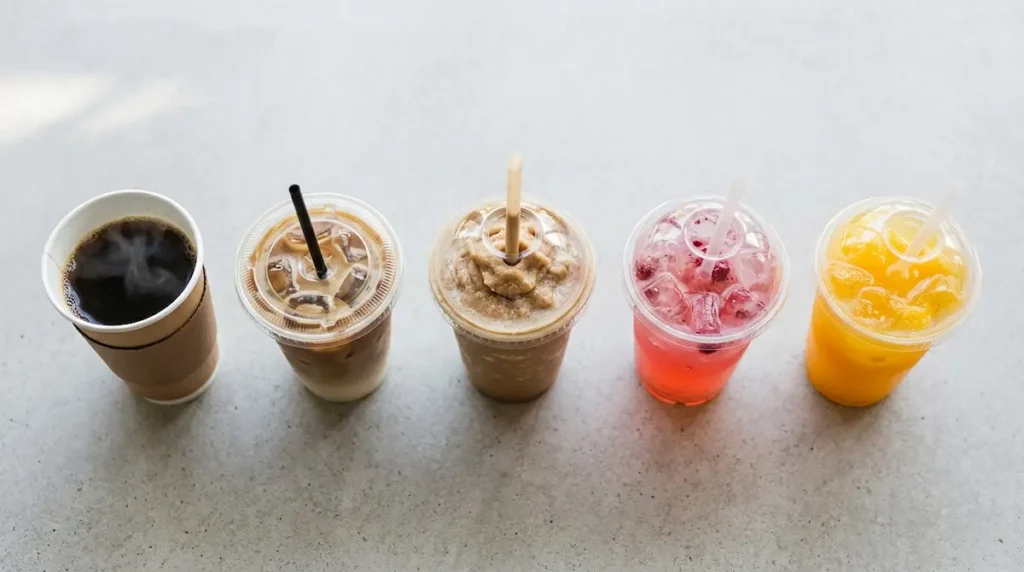
Sugar is the number the drinks menu hides
Tim Hortons publishes sugar in its Canadian nutrition guide. Almost nobody reports it, and the third-party databases that do cannot agree with each other.
For a medium Original Iced Capp alone, compiled sources give 28.6 g, 39 g, 42 g, 46 g and 49 g. That is a spread of more than twenty grams — five teaspoons — for one drink. Several of those figures are calculated against cup volumes that do not match the cups Tim Hortons actually pours.
These are the figures we can stand behind, transcribed from published Canadian nutrition data:
| Drink | Size | Sugar |
|---|---|---|
| Original Blend, black | any | 0 g |
| Steeped or specialty tea, black | any | 0 g |
| Americano | any | 0 g |
| Black iced coffee | any | 0 g |
| Black cold brew | any | 0 g |
| Latte | medium | 13 g |
| Original Iced Capp | small | 38 g |
| Original Iced Capp | medium | 49 g |
| Original Iced Capp | large | 64 g |
Health Canada uses a Daily Value of 100 g total sugars on the Nutrition Facts table, set at 20% of a 2,000-calorie diet. Health Canada is explicit that this is not a recommended intake — it is the amount consistent with a healthy eating pattern where sugars come mostly from fruit, vegetables and plain milk. The World Health Organization separately advises keeping free sugars under 10% of daily energy.
Against the 100 g reference, a large Original Iced Capp is roughly two thirds of the day’s figure. At four grams to a teaspoon, that is sixteen teaspoons in one cup.
Flavoured Iced Capps sit above the Original. The Original is the lightest of the family on both calories and sugar.
Milk instead of cream cuts calories, not sugar
This is the substitution most people get wrong, and it has been documented.
When CBC Marketplace compared the Iced Capp with the Iced Capp Light — the same drink built on milk rather than cream — the Light version came in around 40% lower on calories while the sugar stayed identical between the two at 39 g in a medium.
The mechanism explains it. Cream carries fat. The sugar is in the base syrup, and the base does not change when the dairy does.
So asking for milk is a real saving if you are watching calories or saturated fat. It does nothing at all if you are watching sugar. Two different questions, two different answers, and the menu board distinguishes neither.
The parallel menu: same drink, same price, less sugar
Several cold drinks have a low-sugar twin sold at the same price. Ordering the twin costs nothing.
| Standard build | Twin | What changes |
|---|---|---|
| Original Iced Coffee | Black Iced Coffee | Cream and sugar removed, price unchanged |
| Original Cold Brew | Black Cold Brew | Same, price unchanged |
| Original Iced Latte | Unsweetened Iced Latte | Syrup removed, price unchanged |
| Original Iced Matcha Latte | Unsweetened Iced Matcha Latte | Syrup removed, price unchanged |
| Steeped tea | Steeped tea, black | Nothing added |
The matcha line is worth singling out. When Tim Hortons launched five handcrafted matcha drinks in July 2026, it kept the powder pure rather than pre-sweetening it — which is why an unsweetened version exists at all. Most powder-based drinks on this menu cannot be ordered that way.
Which brings up the constraint nobody prints.
Drinks that cannot be modified
French Vanilla, hot chocolate, white hot chocolate and the coffee mocha are dispensed from pre-mixed powder or syrup bases. Sweetness is fixed before the cup is filled. You cannot order them unsweetened, half-sweet, or with less syrup, because there is no separate syrup step to reduce.
Espresso builds, brewed coffee, tea, cold brew, iced coffee, matcha and the Quencher line are assembled to order. Those are the drinks where asking for a change actually does something.
What costs extra and what does not
Franchisees set their own charges, so exact amounts vary. What is consistent is which category a request falls into.
No charge
- Skim milk in any beverage
- Oat, almond or soy milk in any beverage
- Cream and sugar in brewed coffee
- Milk instead of cream in an Iced Capp
- Ordering any drink black or unsweetened
Charged, amount set locally
- Extra espresso shot
- Cold foam or whipped topping added to a drink that does not include it
- Flavour shots added to drinks that do not list them
The plant-milk line changed recently and most menu sites have not caught up. Tim Hortons confirmed in February 2025 that it would drop the plant-based milk surcharge in Canada and the US, communicated to advocacy group Switch4Good by RBI’s head of global sustainability, Paul Yang. It made Tim Hortons the fourth major chain to remove the charge, after Starbucks in November 2024, Dutch Bros in January 2025 and Scooter’s Coffee.
Before that, the split was narrower than people remember: at the almond rollout there was no charge for skim milk in any drink or for almond in brewed coffee, iced coffee and hot teas, with regional pricing applying to espresso drinks, tea lattes and frozen beverages like Iced Capps. That regional pricing is what has now gone.
Any site still telling you oat milk costs thirty cents is describing 2024.
Quenchers: the flavour changes more than the format suggests
The Quencher line is five flavour bases prepared in several formats. Format sets the broad calorie band, and the full menu covers pricing by format. What no one publishes is that the flavour you pick inside a format moves the number by a consistent amount.
Frozen Quenchers, compiled calorie figures:
| Flavour | Small | Medium | Large |
|---|---|---|---|
| Orange Tangerine | 340 | 400 | 490 |
| Blackberry Yuzu | 330 | 390 | 480 |
| Peach | 310 | 350 | 430 |
| Strawberry Watermelon | 300 | 340 | 410 |
| Pineapple Dragon Fruit | 300 | 340 | 410 |
Lemonade Quenchers, same flavours:
| Flavour | Small | Medium | Large |
|---|---|---|---|
| Orange Tangerine | 130 | 180 | 230 |
| Blackberry Yuzu | 120 | 170 | 220 |
| Peach | 90 | 130 | 170 |
| Strawberry Watermelon | 90 | 120 | 150 |
| Pineapple Dragon Fruit | 80 | 120 | 150 |
Now read them against each other. The flavour order is identical in both formats. Orange Tangerine is heaviest, Blackberry Yuzu next, then Peach, with Strawberry Watermelon and Pineapple Dragon Fruit tied at the bottom.
The gap between heaviest and lightest is 80 calories at a large in both formats. Not proportionally — the same absolute number, in a 490-calorie drink and a 230-calorie one.
That makes flavour a decision you can carry to the counter without a table. Orange Tangerine costs about 80 calories over Strawberry Watermelon at a large, whichever format you order it in.
The line keeps expanding. A Raspberry Mojito Zero Sugar Sparkling Quencher arrived in April 2026, alongside Protein Quenchers built on a lactose-free high-protein dairy beverage at 14 g of protein per medium, in Blackberry Yuzu, Orange Tangerine, Peach, Strawberry Watermelon and Raspberry Mojito. Dates and scope for these sit in the menu changes log.
How these figures were compiled
Sugar values for the drinks named above are transcribed from published Canadian nutrition data, which Tim Hortons calculates using ESHA Genesis R&D software with supplier information and applies nationally.
Quencher flavour calories are compiled third-party figures, cross-checked for internal consistency across formats. They held their ordering in both tables, which is why the pattern is published as structural rather than exact. Treat the ranking as reliable and the individual digit as approximate.
One thing we could not confirm. Several nutrition databases list cold cups at volumes that do not match the hot cup sizes Tim Hortons publishes — an Iced Capp large appears at 648 mL against 591 mL for a large hot cup. If cold cups genuinely run larger, every per-millilitre comparison between a hot and a cold drink is off. We could not verify it against the official guide and have not published per-millilitre figures for cold drinks as a result.
Spotted a charge or a figure we have wrong? Email corrections@timhortonsmenu.com with the item, what you paid and the city.
Frequently asked questions
Which Tim Hortons drink has the most sugar?
A large flavoured Iced Capp. A large Original is around 64 g, and the flavoured builds sit above it. Health Canada’s Daily Value reference for total sugars is 100 g.
Does Tim Hortons charge extra for oat milk?
No. The plant-based milk surcharge was removed in February 2025 across Canada and the US. Oat, almond and soy carry no upcharge in any drink.
Does asking for milk instead of cream reduce sugar?
No. It cuts calories by roughly 40% in an Iced Capp and leaves the sugar unchanged. The sugar is in the base, not the dairy.
Which drinks can be ordered unsweetened?
Iced lattes, iced matcha lattes, cold brew, iced coffee, brewed coffee and tea. French Vanilla, hot chocolate and coffee mocha are pre-mixed and cannot be adjusted.
Are all Fruit Quenchers caffeine-free?
No. The iced tea format is built on black tea and carries caffeine. The sparkling, lemonade and frozen formats do not.
Which Quencher flavour has the fewest calories?
Strawberry Watermelon and Pineapple Dragon Fruit, tied, in every format. Orange Tangerine is the heaviest, by about 80 calories at a large.