
Tim Hortons Calories and Nutrition — Every Item Listed
Since 1 January 2026, a packaged food sold in a Canadian grocery store has to carry a black-and-white magnifying glass reading High in / Élevé en if one serving hits Health Canada’s thresholds for sodium, sugars or saturated fat. Restaurant food is exempt. Run the Tim Hortons Canada menu against those same thresholds and most of the lunch board clears them, several items by a factor of three. The Hat Trick flatbread pizza, listed in the current Canadian guide at 930 calories and 2,390 mg of sodium, carries more sodium in one order than Health Canada’s entire daily upper limit for an adult.
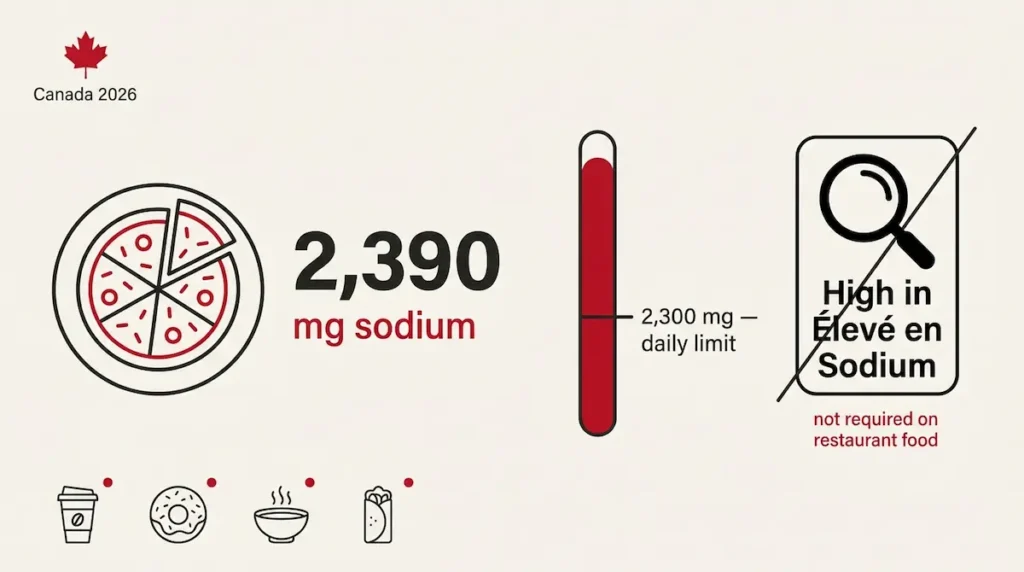
That figure is the highest on the menu. This page ranks the rest against the same yardstick.
The symbol Tim Hortons never has to print
Health Canada finalised the front-of-package rules in July 2022 and gave the food industry until the end of 2025 to comply. The Canadian Food Inspection Agency has said it will not extend that date.
The trigger points are set as a share of the Daily Value:
| Food type | Threshold | Sodium equivalent |
|---|---|---|
| Most packaged foods | 15% DV | 345 mg |
| Small servings (30 g or 30 mL or less) | 10% DV | 230 mg |
| Main dishes (serving over 200 g) | 30% DV | 690 mg |
The sodium Daily Value on a Canadian Nutrition Facts table is 2,300 mg.
A flatbread pizza is a main dish, so its threshold is 690 mg. The Hat Trick sits at 3.5 times that number. The lightest flatbread on the board, Simply Cheese at 630 calories and 1,590 mg, sits at 2.3 times.
The exemption is not an oversight. The regulations apply to prepackaged foods that carry a Nutrition Facts table, and they name restaurant portions specifically — the individually wrapped items served alongside a meal, the creamer beside your coffee. A sandwich assembled at a counter never enters the system.
So the same amount of salt gets a warning label in one building and no label at all in the next.
Sodium: the lunch board, ranked
Breakfast has its own arithmetic, and the breakfast sodium figures are set out separately. Lunch is where the numbers run highest, and it is the part of the menu that grew fastest.
Flatbread pizzas. The heaviest category on the menu, without exception.
| Item | Calories | Sodium | % of the 2,300 mg DV |
|---|---|---|---|
| Hat Trick | 930 | 2,390 mg | 104% |
| Other three chicken, pepperoni and bacon builds | 750–780 | 1,790–1,910 mg | 78–83% |
| Simply Cheese | 630 | 1,590 mg | 69% |
Even the cheese one — no meat, the cheapest build, the one people order when they want the lighter option — clears the main-dish threshold twice over.
Melts. Four items, 1,380 mg to 1,730 mg. A grilled cheese sandwich is the lowest of them and still carries most of a day’s adequate intake.
Loaded wraps and bowls. Wraps run 1,060 mg to 1,360 mg. Bowls run higher, 1,100 mg to 1,500 mg, because the rice base adds volume without diluting the sauce. The Cilantro Lime chicken loaded wrap at 590 calories and 1,060 mg is the lightest of the twelve.
Soups, large size. These are the quiet ones.
| Soup (large) | Sodium |
|---|---|
| Clam Chowder | 1,270 mg |
| Potato Bacon | 1,150 mg |
| Tomato Parmesan | 1,040 mg |
| Spicy Thai | 1,030 mg |
Nobody orders a bowl of soup expecting half a day’s sodium. Soup reads as the restrained choice on a menu full of pizza and melts, and on this measure it is not far behind them.
How to read any number on this menu in three seconds
Health Canada publishes a rule of thumb for the % Daily Value column: 5% or less is a little, 15% or more is a lot.
Applied to sodium at a 2,300 mg Daily Value, 15% is 345 mg. Almost nothing hot on the Tim Hortons menu comes in under it. A hash brown is 220 mg and clears the bar as a genuinely low-sodium item. Past that, the question stops being whether an item is high and becomes how high.
The gap between the two Health Canada numbers matters here, and most menu sites blur them.
- 1,500 mg is the Adequate Intake — the amount an adult is expected to need in a day.
- 2,300 mg is the Tolerable Upper Intake Level — a ceiling, not a target.
One Hat Trick flatbread pizza passes the ceiling. One large Clam Chowder passes 80% of the Adequate Intake before anything is added to it.
For scale: the average Canadian eats 2,760 mg of sodium a day, and 58% of Canadians exceed the recommended limits. Among adults, 97% of men and 81% of women take in more than the Adequate Intake. Bakery products, mixed dishes and processed meats account for roughly half of all the sodium Canadians consume — which is a plain description of a Tim Hortons order.
Where two items become a whole day
Menu figures get published one item at a time. People do not order one item at a time.
| Order | Calories | Sodium | Against the 2,300 mg DV |
|---|---|---|---|
| Hat Trick flatbread pizza | 930 | 2,390 mg | 104% |
| Simply Cheese flatbread + large Clam Chowder | 1,060 | 2,860 mg | 124% |
| Two large soups, chowder and potato bacon | 620 | 2,420 mg | 105% |
| Loaded bowl + a hash brown | 670–930 | 1,320–1,720 mg | 57–75% |
The second row is the one worth sitting with. A soup and a cheese pizza is not an indulgent order. It reads as lunch. It carries more sodium than the daily ceiling and roughly what the average Canadian eats across an entire day, and it does it before dinner.
None of these totals include sauce. Dips add between 170 and 240 calories each, and they are salted.
The bakery case has a sugar problem the drinks get blamed for
The sugars Daily Value in Canada is 100 g. The front-of-package threshold for most packaged foods is 15% of it — 15 g in a single serving.
Nothing in the Tim Hortons bakery case comes in under that.
Standard donuts run between roughly 10 g and 28 g of sugar. The middle of that range clears the threshold comfortably. Muffins run higher again, and the peak of the bakery case sits at 39 g of sugar in one item, in the low 400s for calories, with 20 g of fat.
That is more than two and a half times the packaged-food threshold, in something most people eat standing up.
The part that surprises people is the ranking. Muffins are heavier than donuts — on calories, and by a wider margin on sugar. A muffin looks like the restrained order because it looks like breakfast. It is closer to a slice of cake with fruit in it, and Tim Hortons has never presented it otherwise. The menu just lets the assumption stand.
The Timbit arithmetic is worth correcting too, because the rule of thumb in circulation is wrong in both directions. A Honey Dip Timbit is 50 calories against 250 for the full-size Honey Dip donut — five to one. An Old Fashioned Plain Timbit is 60 calories against 220 for the donut — closer to four to one. So “four Timbits equal a donut” holds for the plain cake varieties and undercounts by a full Timbit on the glazed ones. The ratio moves with the variety, not with the size of the box.
What the guide does not tell you
Tim Hortons publishes ten columns for its Canadian menu: calories, fat, saturated fat, trans fat, cholesterol, sodium, carbohydrates, fibre, total sugars and protein. The figures are calculated with ESHA Genesis R&D software using supplier data, and they apply nationally. A Boston Cream is the same number in Halifax and Saskatoon.
Four limits sit inside the guide’s own preamble, and they are worth knowing before you rely on any figure from anywhere:
- Baked goods vary in size. Tim Hortons states this outright. A donut is a hand-finished product, and the published number is a standard, not a measurement of the one in front of you.
- Assembly at restaurant level causes variation. Two crews build the same wrap slightly differently.
- Limited-time, test and regional items are frequently absent. If a seasonal drink or a new flatbread is not in the guide, no third-party site has real data on it either, whatever they publish.
- The guide is dated and revised. Figures move when recipes move, and several bakery recipes changed through 2025.
There is no caffeine column. Tim Hortons does not publish caffeine for any drink, so every caffeine figure anywhere online is an estimate.
Why the databases disagree
Nutritionix, FatSecret, CalorieKing and the various calculator sites all draw on Tim Hortons data at different points in time and do not date their entries. That is why one site lists a breakfast wrap at 182 calories and another at 650 for the same product name — those are two different builds, two years apart, both published as current.
We have also found third-party pages ranking items that Tim Hortons no longer sells in Canada, and at least one nutrition site publishing a “complete menu guide” whose highest-calorie item is a ten-pack of Timbits. The real figure is more than 1.6 times that, and it is a pizza.
Where our own sources disagreed on a figure, we published the range rather than pick a number. Where a category’s item-level figures could not be matched to individual products with confidence, we published the category range instead. Every single-item number on this page is confirmed against the Tim Hortons Nutrition Guide, Canadian Edition, and at least one independent source.
Frequently asked questions
What is the highest-calorie item at Tim Hortons?
The Hat Trick flatbread pizza at 930 calories, which also carries the menu’s highest sodium load at 2,390 mg and 52 g of fat.
What is the highest-sodium item at Tim Hortons?
The same flatbread pizza, at 2,390 mg. Health Canada’s upper limit for adults is 2,300 mg for a full day.
Would Tim Hortons items carry Canada’s new “High in” warning symbol?
Most of the hot menu would if the rules applied. They do not. Since January 2026 the symbol is mandatory on prepackaged foods that meet the thresholds, and restaurant-prepared food is exempt from the regulation.
How much sodium is too much in one meal?
Health Canada sets the adult Adequate Intake at 1,500 mg a day and the upper limit at 2,300 mg. A single serving carrying 15% or more of the 2,300 mg Daily Value — 345 mg — counts as high under Health Canada’s own labelling guidance.
Are Tim Hortons muffins healthier than the donuts?
No. Muffins run higher on calories than any standard donut and considerably higher on sugar. The heaviest bakery item carries 39 g of sugar in one serving.
Do Tim Hortons nutrition figures change by location?
No. Nutrition is calculated nationally and applies to every Canadian restaurant. Prices vary between franchises; calories do not.
Which Tim Hortons soup has the most sodium?
A large Clam Chowder at 1,270 mg, followed by Potato Bacon at 1,150 mg. Tomato Parmesan and Spicy Thai both sit near 1,030 mg.
What can I eat at Tim Hortons on keto or low-carb?
Black coffee, espresso and unsweetened teas are the lowest-carb drinks — the real cost is the sugar: one packet adds 7–9 g of carbs, so a Double Double’s two sugars run 14–18 g. Omelette Bites are the best food pick at 6 g carbs and 15 g protein. Full order scripts, the per-size cream/milk/sugar carb table, and the traps (the Iced Capp Light carries 44 g of carbs) are in our Tim Hortons keto & low-carb guide.