
Tim Hortons Caffeine Content — Every Drink and Size
A medium Tim Hortons Original Blend contains about 205 mg of caffeine. A small is around 140 mg, a large 270 mg, and an extra large 330 mg. Tim Hortons does not print caffeine figures on its menu or in its Canadian nutrition guide, so every number on this page is a compiled estimate, and the section at the bottom explains exactly where they come from and where they disagree.
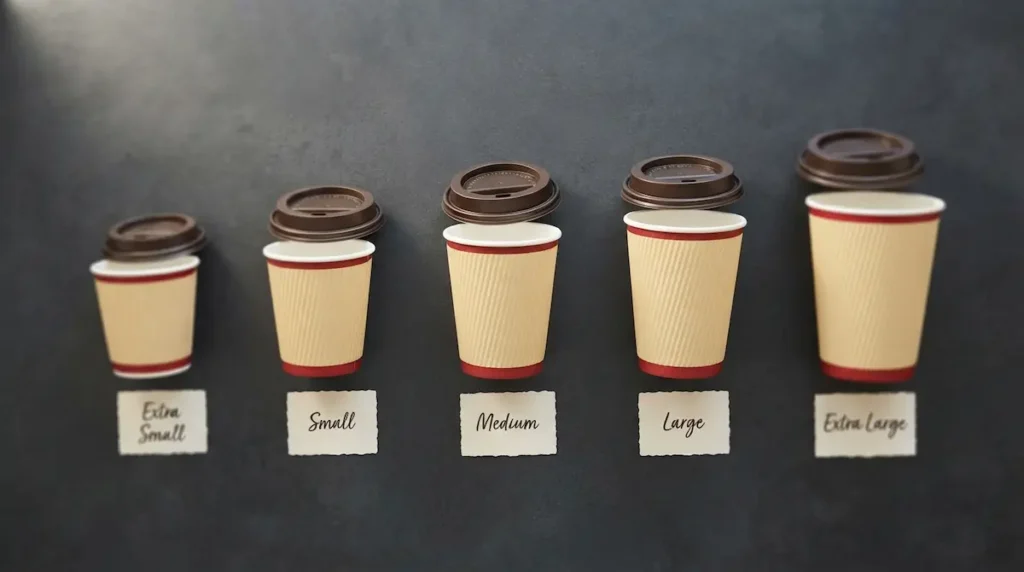
The full caffeine matrix
Hot drinks, by cup size. Figures in milligrams.
| Drink | Small (296 mL) | Medium (414 mL) | Large (591 mL) | Extra Large (710 mL) |
|---|---|---|---|---|
| Original Blend | 140 | 205 | 270 | 330 |
| Dark Roast | 130 | 195 | 260 | 315 |
| Decaf brewed | 6 | 9 | 12 | 15 |
| Steeped Tea | 90 | 125 | 175 | 210 |
| Black bagged tea | 50 | 70 | 100 | 170 |
| Chai bagged tea | 50 | 70 | 100 | 170 |
| Green bagged tea | 25 | 35 | 50 | 60 |
| White tea | 12 | 20 | 25 | 30 |
| Decaf orange pekoe | 6 | 9 | 12 | 15 |
| Hot chocolate | 15 | 20 | 30 | 35 |
| French Vanilla | 60 | 80 | 110 | 135 |
A Double Double and a Triple Triple carry the same caffeine as the Original Blend they are built on. Cream and sugar change calories, not milligrams. The same holds for flavour shots.
Espresso and cold drinks sit on a different logic, covered below.
| Drink | Serving | Caffeine |
|---|---|---|
| Espresso | single shot | 60–80 mg |
| Espresso | double shot | 120–160 mg |
| Americano | any size | 60–160 mg, by shot count |
| Latte, Cappuccino, flavoured lattes | any size | 60–160 mg, by shot count |
| Iced Latte | any size | 60–160 mg, by shot count |
| Iced Coffee | medium | about 130 mg |
| Iced Coffee | large | about 160 mg |
| Iced Capp | medium | 90–145 mg |
| Matcha Latte | medium | 60–80 mg |
| Infusr energy beverage | one can | 80 mg |
| Cold Brew | any size | no verified figure published |
Strength per milliliter: Tim Hortons is weaker than its reputation
The headline numbers look large because the cups are large. Divide by volume and a different picture appears.
| Drink | Caffeine per 100 mL |
|---|---|
| Original Blend | 46–50 mg |
| Dark Roast | 44–47 mg |
| Steeped Tea | about 30 mg |
| Infusr | about 23 mg |
| Chai or black bagged tea | about 17 mg |
| Green bagged tea | about 9 mg |
| Hot chocolate | about 5 mg |
| Decaf brewed | about 2 mg |
Now compare that with Health Canada’s own reference figures, which are published per 237 mL cup:
- Brewed coffee, average: 135 mg, or 57 mg per 100 mL
- Roasted and ground, filter drip: 179 mg, or 75.5 mg per 100 mL
- Roasted and ground, percolated: 118 mg, or 49.8 mg per 100 mL
Tim Hortons brews at roughly 47 mg per 100 mL. That sits below Health Canada’s general brewed-coffee average and well below its filter-drip figure. Scaled to a standard 237 mL cup, a Tims coffee would deliver about 111 mg against the 135 mg national average.
So the extra large that reaches 330 mg does not do it by brewing hard. It does it by holding 710 mL. Cup size is doing the work, not the roast.
This also settles a common assumption: Dark Roast has slightly less caffeine than Original Blend at every size, not more. Darker roasting burns off a small amount of caffeine and produces a bolder flavour. Taste and stimulant strength move in opposite directions here.
Steeped tea is stronger than most people assume
Health Canada puts brewed black or green tea at 30 to 50 mg per 237 mL. Tim Hortons steeped tea works out to roughly 30 mg per 100 mL, which is around 71 mg per 237 mL. That is well above the national tea reference and close to two thirds the strength of their coffee, millilitre for millilitre.
The practical consequence catches people out:
- An extra large steeped tea at 210 mg beats a small coffee at 140 mg.
- A large steeped tea at 175 mg beats a double espresso.
- A medium steeped tea at 125 mg is roughly a Red Bull and a half.
Steeped tea is double-strength orange pekoe held in an urn, not a bag dunked in a cup. If you switch from coffee to tea in the afternoon expecting a lighter dose, the switch has to be to a bagged green tea (25–60 mg) or a herbal infusion, not to steeped tea.
Espresso drinks do not scale with cup size
This is the single most misread part of the menu. A latte is espresso plus milk. Going from small to large adds milk. It does not add espresso unless you ask.
A small latte and a large latte built on the same shot count carry the same caffeine. The large costs about a dollar more and delivers roughly 295 mL of extra milk. If you are ordering a large latte for the caffeine, you are paying for dairy.
Two ways to get more:
- Ask for an extra shot. Adds roughly 60–80 mg for a small upcharge.
- Order an Americano instead. Espresso and hot water, no milk, and the cheapest espresso-based drink on the board.
The reverse is useful too. If you want the flavour of coffee late in the day with a manageable dose, a small latte at 60–80 mg is a fraction of a medium brewed coffee at 205 mg.
Cold brew: what is actually known
Tim Hortons publishes nothing for cold brew, and the compiled tables everyone quotes were assembled before cold brew reached Canadian restaurants. Any site giving you a precise cold brew figure for Tim Hortons is filling a gap with a guess.
What can be said with confidence is the mechanism. Cold brew steeps coarse grounds in cold water for 12 to 24 hours. The long contact time extracts more caffeine per millilitre than a two-minute drip cycle, even though the result tastes smoother because far less acid comes out with it. Smooth and strong are not opposites.
For scale, at other chains where figures are published, cold brew runs above drip at the same volume. Starbucks lists a 473 mL cold brew at 205 mg; Dunkin’ lists a medium cold brew at 260 mg. Treating a Tim Hortons cold brew as at least as strong as the same size of Original Blend is the safe assumption until real figures exist.
The cold foam builds on top add negligible caffeine unless the foam itself is espresso-infused, in which case add roughly one shot.
Decaf still contains caffeine
Decaffeination removes most of the caffeine, not all of it. Canadian regulations allow a residual amount, and Tim Hortons decaf lands at 6 mg in a small and 15 mg in an extra large.
To put 15 mg in context: that is about the caffeine in a cup of instant tea, roughly a fifth of a cola, and about one twenty-second of an extra large regular coffee.
For most people that is genuinely negligible. For someone medically instructed to eliminate caffeine, or drinking six decafs a day, it accumulates to around 90 mg, which is more than a small espresso.
Caffeine per dollar
Nobody publishes this, and it is the one calculation that changes ordering behaviour. Using typical Canadian price ranges:
| Order | Caffeine | Typical price | Per dollar |
|---|---|---|---|
| Extra large Original Blend | 330 mg | about $2.52 | 131 mg |
| Large Original Blend | 270 mg | about $2.18 | 124 mg |
| Medium Original Blend | 205 mg | about $1.96 | 105 mg |
| Small Original Blend | 140 mg | about $1.62 | 86 mg |
| Extra large steeped tea | 210 mg | about $2.64 | 80 mg |
| Medium steeped tea | 125 mg | about $1.99 | 63 mg |
| Single espresso | 60–80 mg | $1.49 | 40–54 mg |
| Infusr energy beverage | 80 mg | about $4.29 | 19 mg |
The gap at the two ends is close to sevenfold. An extra large brewed coffee delivers roughly seven times the caffeine per dollar of the canned energy drink sold at the same counter, and the energy drink carries less total caffeine than a small coffee.
Brewed coffee is the efficient buy at every size. Espresso drinks are priced for milk and labour, not stimulant.
Drinks people think are caffeine-free but are not
- Hot chocolate contains caffeine. Cocoa solids carry it naturally, which puts a small at around 15 mg and an extra large at around 35 mg. That is small for an adult and not small for a seven-year-old, as the next section shows.
- Iced tea Quenchers contain caffeine. The Quencher line has five preparation formats. The iced tea format is built on black tea and carries a meaningful dose. The sparkling, lemonade, frozen and cloud formats are fruit-based and are not caffeinated.
- Colas contain caffeine. A 355 mL regular or diet cola runs 36 to 50 mg.
- French Vanilla contains caffeine. It is a powder-based drink, not a hot chocolate, and lands at 60 to 135 mg depending on size.
- Genuinely caffeine-free: white hot chocolate, Creamy Chills without an added shot, frozen lemonade, sparkling and lemonade and frozen Quenchers, herbal and fruit specialty teas, juices, milk, bottled water, Sprite and Canada Dry ginger ale.
Health Canada limits, applied to real orders
Health Canada publishes a recommended maximum daily intake by group:
| Group | Daily maximum |
|---|---|
| Adults, 18 and over | 400 mg |
| Planning pregnancy, pregnant, or breastfeeding | 300 mg |
| Children and adolescents to 18 | 2.5 mg per kg of body weight |
Health Canada also gives age-banded figures for younger children: 45 mg for ages four to six, 62.5 mg for seven to nine, and 85 mg for ten to twelve.
Applied to the menu:
Adults. One extra large Original Blend at 330 mg is 83% of the daily figure in a single cup. Two mediums come to 410 mg, which is already past it. Three larges reach 810 mg.
Pregnancy. The 300 mg ceiling is exceeded by one extra large coffee on its own. A large at 270 mg uses 90% of it. A medium at 205 mg leaves room for roughly one bagged tea and nothing else. Some bodies, including EFSA and ACOG, advise a lower 200 mg ceiling during pregnancy, which a single medium coffee would nearly reach.
Children. A 25 kg nine-year-old has a 62.5 mg ceiling. A small hot chocolate at 15 mg fits comfortably. A small steeped tea at 90 mg does not. A medium steeped tea at 125 mg is roughly double the limit for that age band. Steeped tea is the item worth watching on a family order, not the hot chocolate.
Timing: when to stop if you want to sleep
Caffeine has a half-life of roughly three to five hours in healthy adults, meaning half the dose is still circulating five hours later and a quarter is still there after ten.
An extra large coffee at 330 mg finished at 3pm leaves around 165 mg in the system at 8pm and about 82 mg at 1am. That 82 mg is close to a full espresso, still working, at the hour you are trying to sleep.
Working backwards from a target bedtime is more useful than a blanket rule. If you are asleep by 11pm and want under 50 mg on board, a medium coffee needs to be finished by early afternoon. A small latte can go much later.
Half-life stretches considerably in pregnancy, reaching around 10.5 hours in the final weeks, which is why the lower daily ceiling matters more than the arithmetic suggests.
How Tim Hortons compares at matched volumes
Most comparisons are meaningless because they line up a Tim Hortons large against a Starbucks grande, which are different volumes. Matched properly, at 20 fluid ounces of brewed coffee:
| Chain | 20 fl oz brewed coffee |
|---|---|
| Starbucks Pike Place, Venti | 410 mg |
| Tim Hortons Original Blend, Large | 270 mg |
| Dunkin’ Coffee, Large | 270 mg |
| McDonald’s Premium Roast, Large | about 180 mg |
At identical volume Starbucks delivers about 52% more caffeine than Tim Hortons, and McDonald’s about a third less. Tim Hortons and Dunkin’ are identical at 20 oz and identical again at 24 oz, where both reach 330 mg. They diverge at the small end, where Dunkin’ pours 180 mg against Tim Hortons’ 140 mg.
Starbucks Blonde Roast is stronger still, reaching 475 mg in a Venti, which is above Health Canada’s entire daily figure in one cup.
Why these numbers conflict, and which to trust
Tim Hortons has never published caffeine data on its menu. Its Canadian nutrition guide lists calories, fat, cholesterol, sodium, carbohydrate, fibre, sugar and protein. There is no caffeine column for any drink.
The figures in circulation trace back to a caffeine report produced by Tim Hortons’ own research and development department in Ontario, compiled and published by Caffeine Informer. That table is the source for effectively every caffeine page about this chain, and it carries three limitations worth knowing about:
It is dated. The compilation still lists products retired years ago, including Dream Lattes, English Toffee Cappuccino and Hot Smoothees, and contains nothing for cold brew, matcha or Infusr.
Its Canadian and American columns disagree. The same drink appears at different values in each. A medium hot latte is listed at 205 mg in one column and 50 mg in the other. The espresso shot is 125 mg in one and 45 mg in the other. Independent laboratory work on espresso, published in the Journal of Analytical Toxicology, puts a typical shot in the 58 to 76 mg range, which is why this page uses 60 to 80 mg rather than either published extreme.
Its stated cup volumes are wrong. It gives Canadian sizes as 286, 425, 563 and 678 mL. The actual cups are 296, 414, 591 and 710 mL. Any per-millilitre figure calculated from those volumes is off, which is why the per-100 mL table above was recalculated against real cup sizes.
Beyond the source, brewed coffee varies genuinely. Grind size, dose, water temperature, contact time, bean origin and how full the cup is poured all move the result. Two identical orders at the same restaurant on the same morning will not match exactly. Treat every figure here as the centre of a range, not a reading.
One number on the menu is legally reliable. Because caffeinated energy beverages must declare their caffeine content in Canada, Infusr’s 80 mg per can is a stated figure rather than an estimate. It is the only drink at Tim Hortons where that is true.
Frequently asked questions
How much caffeine is in a Tim Hortons double double?
The same as the coffee underneath it. A medium double double is around 205 mg. Cream and sugar add calories, not caffeine.
Does Tim Hortons dark roast have more caffeine than Original Blend?
No. Dark Roast comes in slightly lower at every size, around 195 mg for a medium against 205 mg. Darker roasting drives out a small amount of caffeine while producing a bolder taste.
Which Tim Hortons drink has the most caffeine?
An extra large Original Blend at roughly 330 mg. Cold brew may match or exceed it at large sizes, but no verified figure exists.
Is Tim Hortons coffee stronger than Starbucks?
No. At the same 20 fl oz volume, Starbucks Pike Place runs about 410 mg against 270 mg for Tim Hortons, and Starbucks Blonde Roast reaches 475 mg in a Venti.
How much caffeine is in a Tim Hortons Iced Capp?
Roughly 90 to 145 mg for a medium. It is a blended coffee drink, so it carries less than the same volume of brewed coffee.
Can I drink Tim Hortons coffee while pregnant?
Health Canada sets a 300 mg daily maximum during pregnancy. One extra large exceeds that on its own and one large uses 90% of it. A small at 140 mg leaves reasonable room. Some international bodies advise a lower 200 mg ceiling.
Is Tim Hortons hot chocolate caffeine free?
No. Cocoa contains caffeine naturally, putting hot chocolate at roughly 15 mg in a small and 35 mg in an extra large. White hot chocolate is effectively caffeine-free, because it contains no cocoa solids.
How much caffeine is in Tim Hortons decaf?
About 6 mg in a small and 15 mg in an extra large. Decaffeinated is not caffeine-free.
Does a large latte have more caffeine than a small one?
Not unless you ask for an extra shot. Espresso drinks scale by shot count. The larger size adds milk.
What can I order at Tim Hortons with no caffeine at all?
White hot chocolate, frozen lemonade, Creamy Chills without an added shot, sparkling and lemonade and frozen Quenchers, herbal specialty teas, juices, milk, water, Sprite and ginger ale.