
Tim Hortons Prices by Province — Tax and Totals 2026
Tim Hortons menu prices are set by individual franchisees, so the board price moves between provinces and between two restaurants in the same city. The tax added at the till does not move that way — it is provincial law, identical at every restaurant in the province, and you can work it out before you order. It runs 5% in Alberta and the territories, 11% in Saskatchewan, 12% in Manitoba, 13% in Ontario, 14% in Nova Scotia, 14.975% in Quebec and 15% in New Brunswick, Newfoundland and Labrador and Prince Edward Island. British Columbia charges 5% on coffee and food but 12% on fountain drinks, and Ontario drops to 5% on qualifying orders of $4.00 or less.
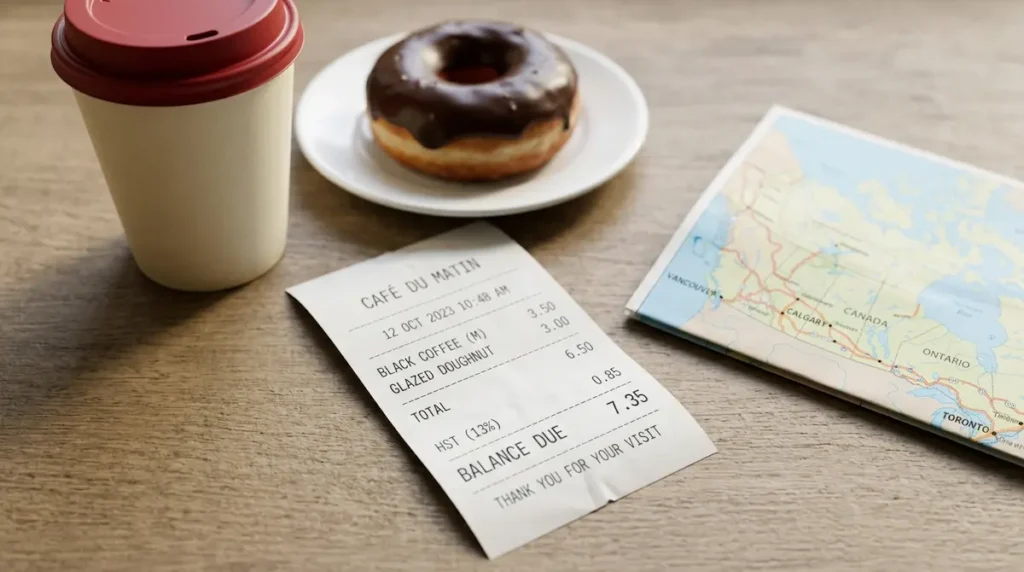
The menu price is local. The tax is not.
These are two different numbers, and treating them as one is why most price guides get this wrong.
The board price is a franchise decision. Head office publishes no national price list, which is why a medium Original Blend at $1.83 in one town and $2.09 in the next are both correct. What drives that spread — rent, labour, location type — is set out on the full menu.
The tax is not a franchise decision. It is written in provincial and federal law, applies identically at every restaurant in the province, and is the only part of your total you can predict before you walk in.
What actually gets added at the till
Every price on this site is before tax. This is what lands on top.
| Province or territory | Tax on a Tim Hortons order |
|---|---|
| Alberta, Yukon, NWT, Nunavut | 5% GST |
| British Columbia | 5% GST — coffee and food are PST-exempt |
| Saskatchewan | 11% — 5% GST + 6% PST |
| Manitoba | 12% — 5% GST + 7% RST |
| Ontario | 13% HST, or 5% on qualifying orders of $4.00 or less |
| Nova Scotia | 14% HST |
| Quebec | 14.975% — 5% GST + 9.975% QST |
| New Brunswick, Newfoundland and Labrador, PEI | 15% HST |
Three of those rows are out of date on most menu pages, including two that were out of date here until this page was written.
Nova Scotia moved last year
Nova Scotia cut its HST from 15% to 14% on 1 April 2025, taking the provincial share from 10% to 9%. It was the first GST/HST rate change anywhere in Canada since 2016, and it left Nova Scotia as the only jurisdiction in the country at 14%.
Any table still grouping Nova Scotia with New Brunswick, Newfoundland and PEI is describing March 2025.
British Columbia puts two rates on one receipt
BC exempts food for human consumption from PST, and the exemption specifically names non-alcoholic hot and cold beverages including coffee and iced tea. A coffee, a donut, a breakfast sandwich and an Iced Capp all carry 5% GST and nothing else.
Soda beverages are the exception, at 7% PST. The province defines them as carbonated or effervescent drinks containing sugar or any sweetener, natural or artificial — which covers fountain pop, bottled soft drinks, sparkling sweetened water and carbonated energy drinks.
Then a second rule most people never hear about: 7% PST applies to every beverage dispensed by a soda fountain or soda gun, whether or not the drink is a soda. A fountain lemonade is taxed like a cola because of the machine it came out of.
So a coffee and a fountain pop bought together in Vancouver carry two different tax rates on one receipt. No other province does that.
Manitoba’s July 2026 change stops short of the counter
Manitoba expanded its RST exemption on food and beverages on 1 July 2026, and much of the coverage described it as taking tax off prepared food.
It does not reach Tim Hortons. Manitoba Finance names restaurants, coffee shops, bakeries, food courts, cafeterias, concession stands and food trucks as still taxable. The exemption applies to grocery shopping. A sandwich off a Winnipeg grocery shelf is now RST-free; the same sandwich at a Tims counter is not.
Winnipeg is still 12%.
Ontario’s $4.00 cliff
Ontario is the only province where the tax rate on your order depends on the size of your order.
The province rebates the 8% provincial share of HST on qualifying prepared food and beverages, so a qualifying order pays 5% instead of 13%. The CRA administers it and the restaurant applies it at the till automatically.
Two conditions decide whether you get it, and both are read wrong constantly.
It is the whole transaction, not the item. The $4.00 ceiling applies to the total of every qualifying item sold at one time, before tax. A coffee at $1.96 qualifies on its own. A coffee and two donuts at $5.54 does not — and the rebate is lost on the entire order, including the coffee that would have qualified by itself.
The edge is sharp. An order of exactly $4.00 costs $4.20 at the till. An order of $4.01 costs $4.53. One cent of menu price costs you 33 cents, and there is no partial rebate on the way through.
Splitting a larger order into two transactions of under $4.00 each preserves it. That is not a loophole; it is how the threshold is written.
The rule that catches Timbits
Doughnuts, muffins, cookies, tarts and similar bakery items qualify only when sold as single servings in quantities of fewer than six.
A 10-pack of Timbits at $2.99 sits well under the $4.00 ceiling and still fails on count. So does a 20-pack, a 50-pack, a half dozen donuts and a dozen. Price is not the only test.
Coffee is unaffected. It qualifies as a beverage heated for consumption at any size.
The same order, priced in eight places
A medium Original Blend and a Boston Cream, using the midpoints of the ranges published across this site: $3.75 before tax.
| Where | You pay |
|---|---|
| Calgary, Edmonton | $3.94 |
| Vancouver | $3.94 |
| Toronto, Ottawa | $3.94 |
| Saskatoon, Regina | $4.16 |
| Winnipeg | $4.20 |
| Halifax | $4.28 |
| Montreal, Quebec City | $4.31 |
| Saint John, St. John’s, Charlottetown | $4.31 |
Toronto ties Calgary. Ontario’s headline rate is more than double Alberta’s and on this order it makes no difference at all, because $3.75 clears the threshold.
Now add one more donut. At $5.54 before tax, Calgary comes to $5.82 and Toronto to $6.26. A 44-cent gap opens the moment the order crosses $4.00.
That is the real shape of coffee tax in Canada. It is not a league table of provinces. It is a threshold, and one province sits right on it.
Where the restaurants actually are
Ontario holds roughly half of every Tim Hortons in Canada. Counting them precisely is harder than it should be — compiled totals run from about 3,570 to just over 4,000 depending on the date and whether in-store kiosks are counted, and Tim Hortons publishes no provincial breakdown at all.
The proportions hold steady across sources: Ontario about 51%, Quebec 16%, Alberta 11%, British Columbia 9%.
Measured per person, the ranking inverts.
| Province | People per restaurant |
|---|---|
| New Brunswick | about 7,400 |
| Nova Scotia | about 7,700 |
| Ontario | about 8,200 |
| Prince Edward Island | about 9,100 |
| Newfoundland and Labrador | about 10,500 |
| Alberta | about 11,400 |
| Manitoba | about 14,200 |
| Quebec | about 15,100 |
| Saskatchewan | about 15,600 |
| British Columbia | about 15,600 |
New Brunswick has the most Tim Hortons per person in Canada, and among the highest tax on them. British Columbia has roughly half Ontario’s density and one of the lowest effective rates. Density and cost do not travel together.
City counts, where sources broadly agree: Toronto 171–182, Calgary 129–132, Edmonton 108–111, Mississauga 106–111, Winnipeg 76–80, Montreal 70–72.
Delivery is a different price for a different reason
Uber Eats, DoorDash and SkipTheDishes list item prices above what the same restaurant charges at the counter — commonly 10% to 25% higher, before delivery fees, service fees and tips. Nothing on this site reflects delivery pricing.
One province regulates what sits behind that markup. British Columbia’s Food Delivery Service Fee Act, in force since 1 January 2023, caps what delivery companies can charge a restaurant at 20% of the order value, made up of 15% on food and 5% in other fees. It is the only permanent cap in Canada. Ontario, Nova Scotia, Saskatchewan and Quebec all ran temporary caps during the pandemic and let them expire.
Everywhere else commissions reach about 30%, and Uber Eats raised its entry tier in March 2026. Menu markup is how franchisees absorb that.
Checking your own restaurant
Three things this page cannot tell you: what your restaurant charges, whether it stocks the item, and what your receipt will total.
The Tim Hortons app loads the live menu and current pricing for whichever restaurant you select. Prices load per location, which is the entire point of checking there rather than anywhere else.
The tax you can work out before you leave the house. The board price you cannot.
How this page was compiled
Tax rates are taken from federal and provincial sources. Ontario’s rebate conditions, including the $4.00 transaction threshold and the fewer-than-six bakery rule, are from CRA GST/HST Info Sheet GI-064. British Columbia’s soda beverage and soda fountain rules are from the province’s published guidance for food and beverage service providers. Manitoba’s exclusions are from Manitoba Finance guidance on the July 2026 exemption.
The prices in the worked example are midpoints of the ranges published across this site, before tax. They are typical figures, not quotes.
Restaurant counts are compiled third-party figures that disagree with one another, which is why they appear here as ranges. Tax rules change; confirm current rates with the CRA or your provincial authority before relying on them for anything that matters.
Paid something different? Email corrections@timhortonsmenu.com with the item, the price and the city. Local reports are what tighten the ranges.
Frequently asked questions
How much tax is added to a Tim Hortons order in Ontario?
13% HST on most orders, or 5% where the qualifying prepared food and beverages in that transaction total $4.00 or less before tax. The test applies to the whole order, so adding one item can move everything to 13%.
Why does my Tim Hortons receipt only show 5% tax in Ontario?
Ontario rebates the 8% provincial portion of HST on qualifying prepared food and beverages sold for $4.00 or less. A single coffee, or a coffee and a donut under the threshold, is charged 5%.
Is Nova Scotia still 15% HST?
No. Nova Scotia reduced its HST to 14% on 1 April 2025 and is the only jurisdiction in Canada at that rate.
Do you pay PST on coffee in British Columbia?
No. BC exempts food and non-alcoholic hot and cold beverages from PST, so coffee is 5% GST. Fountain drinks and soda beverages carry 7% PST on top, making them 12%.
Did Manitoba take the tax off Tim Hortons in July 2026?
No. The expanded RST exemption covers grocery purchases. Manitoba Finance lists restaurants and coffee shops as still taxable, so a Winnipeg order remains 12%.
Which province has the cheapest Tim Hortons?
No province is cheapest outright, because franchisees set their own board prices. On tax alone, Alberta and the territories are lowest at 5%, and Ontario matches them on qualifying orders of $4.00 or less.
Where are there the most Tim Hortons per person?
New Brunswick, at roughly one restaurant for every 7,400 people, ahead of Nova Scotia and Ontario. Ontario has the most restaurants in absolute terms, around half the national total.